jeudi 20 mai 2010

Other towns and cities

Those of you who read my last post will know that I'm looking for a place of my own. It seems the right time then to tell you all about my first experience living in a shared flat. At the end of 2004, unsure of my direction in life, I took a job in an international school as an Economics teacher in Aix-en-Provence, regardless of the fact that it only involved seven hours of work a week and was far away from anyone I knew in France. Arriving at the futuristic TGV station, still bleary eyed from the early morning train ride, I caught sight of the majestic Mont St. Victoire rising up on the horizon as I travelled into the centre on the shuttle bus. Aix is extremely pretty with little parks dotted all around where old men play boules and sit on park benches accompanied by the delicate song of fountains. In spite of that, I failed to appreciate my time there because I felt so absolutely alone. Although I'd managed to convince the directrice of the school that I was more than qualified to teach economics, having done it as one of my A levels, I was well aware of being embaressingly hopeless when it came to my classes. Basically, anything with numbers or equations makes me want to run away screaming and just the whole concept of elasticity was enough to make me feel like bursting into tears. Things might not have seemed so bad if I'd had somewhere permanent to live. Every day I'd spend hours in Internet cafés looking for a place but it didn't work out so I ended up staying in hotels. One was rather seedy on the other side of town and the other was close to the centre, nicer and with a friendly receptionist who advised me to try temping agencies like she had done to get more experience. To pass the time in Aix, I would drown my sorrows in a large bol of café au lait and eat several cakes at an exquisite patisserie close to the main square.

I'm the kind of person who suddenly has completely crazy ideas which I'm convinced are brilliant, like the time when I decided I could carry a table back from Ikea but that's another story. Sitting at the internet café one evening, I imagined how wonderful it'd be to get a place in Lyon, work there for three days, then commute to Aix for the other two. My eyes lit up when I saw the long list of rooms advertised in Lyon; I had heard someone say that the première arrondissement was the coolest so naturally, I looked there first, called a number and fixed an appointment for the coming Sunday morning. I remember it was the first weekend of the New Year, it was impossible to get a seat on the train so I paid a huge amount of money for a chance to sit on a strapontin, or pull out seat, in first class. The flat turned out to be on the slopes above the city in the middle of a leafy square. Nervously, I rang the bell and marched up several flights of stairs to the fourth floor where a blonde girl opened the door. She was S., a Berliner working as an assistante for a few months in one of the lycées. I was ushered into the flat, shown briefly round the kitchen and introduced to E. who was to decide upon the new colocataire or flatmate. He was tall, lean and seemed a little sarcastic but friendly enough. We all drank coffee in the huge living room with its high ceiling and wooden beams. There were windows on all sides and one could look across not only to the Fourvière church perched high up over the city, but also to the Crayon (pencil) building and beyond that sometimes to the Mont Blanc on clear days. Sitting at that table, I longed to be accepted, to wake up each morning in that apartment and share everything with my two flatmates. I need never be lonely again. When the time finally came for me to leave, I had all my hopes pinned on that one place and if it fell through, I honestly didn't know what I'd do.

Luckily, the call from E. came that same evening when I was in the TGV on my way back to Aix. My new flatmates would wait to eat with me the night of my arrival and there was an enormous sense of relief that I finally belonged somewhere. Sadly it wasn't to be; that first evening that I'd been so looking forward to actually decided my fate. E. asked me if I wanted soup and I made the mistake of asking what kind it was and then when he asked me if I wanted it mixte ou pas mixte (blended or unblended), he looked horrified when I said pas mixte. At least I imagine that was my gaffe because from that moment on, he hated me with a burning, silent passion. Whereas with S. and other friends, he could be charming and funny, with me there was the barely exchanged "Salut" in the morning and a sulky grimace. He occupied a room next to the kitchen where he would sit from the moment he came in from work until the early hours of the morning, working on his computer but also observing the comings and goings in the apartment. The living room became the cemetary for old computers which he'd pile up to repair and copies of the Chef d'Entreprise magazine covered his desk. He obviously liked to think of himself as the boss.


He detested the fact that I used to bake cakes which he considered strange because they weren't French, made fun of my cooking, although he had a point when he complained that boiled vegetables were tasteless and the cliché anglais, even though he himself typically ate pasta with ketchup. Maybe he didn't like me because he felt threatened by someone intelligent or because I wasn't one of those blonde German girls he seemed to prefer. Overhearing his conversations with S. on the sofa, I felt excluded and didn't know why. S. told me one evening that she didn't understand why E. and I hated each other but was sure it simply a misunderstanding. The low point came though when she returned to Berlin for the winter holidays, leaving me alone in the flat with him. At that time, I barely knew anyone in Lyon and had very little money so couldn't go out anywhere. After spending a few days with him, I remembered an autobiographical story by Albert Camus where he described the unbearable loneliness that overcame him with the realisation that he hadn't talked to anyone in days. My only comforts were learning German with a book about a French businessman who goes to Cologne, cycling through the city and trips to the Part Dieu library where I spent hours reading books about mountains with the somewhat ridiculous ambition of making it to the top of the Meije one day. I'd get up at regular intervals to drink coffee from the machine in the break room and eat a Twix. The thought of the combined tastes of synthetic capuccino with that biscuit and caramel horrifies me now but at least it was chance to chat to some of the other people.

When S. returned to Berlin definitively, she was replaced by B. who had been studying in Finland. I'd hoped that being the only girl in the flat would improve but I was an outsider from the others who had known each other from school. With E., things deteriorated even more and he simply sent B. as a messenger to inform me when we'd do the cleaning or ask me to contribute to the purchase of the washing machine. His presence around me made me feel nervous and uneasy; once I was asked to prepare a dessert, decided upon a chocolate cake which went disastrously wrong when I used too much butter and ended up with a dark, greasy mess. E. looked disgusted when I served it, even more so when a friend of his raved over the fact that it managed to be crispy on the outside and squidgy in the middle.

On the day I moved out before leaving for Alsace, we said our farewells. I don't remember whether we kissed each other on the cheek, but only that he sent B. one last time to check that I didn't forget to leave the keys in the mailbox! Occasionally I wonder what became of him. Someone told me they saw a child's seat in the back of his car recently and I hope things worked out for him, irrespective of our differences. Yet most of all, I'm glad not to share a flat with him anymore.

Last Sunday was a special day for me because I finally got a chance to try the new camera out. It's still early days and I have a lot more to learn before I feel 100% confident but already I have the impression there are some good times ahead of us.

Rainy days


At the freshly re-opened Neues Museum


This statue reminds me of the smile that so fascinated Jules et Jim in Truffaut's film


Marzipan and chocolate torte at the museum café

Pour Rose - unfortunately, the special edition costs €750 so I can't send it to you.

Evening falls on Savignyplatz


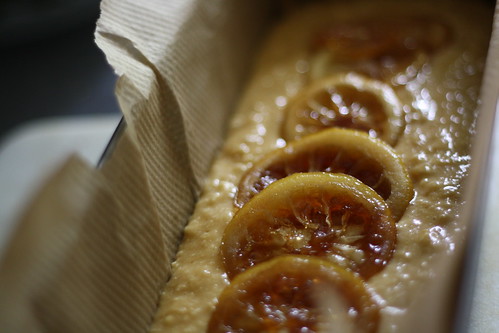
Regular readers of this blog will already be aware of my love for all things with lemon. I even managed to pick up a bottle of limoncello liqueur at my local store so now there's no excuse for not making a torta al limone. In the meantime though, I tried out another Nigel Slater recipe, with lemons of course!

Brown sugar lemon cake (from Nigels Slater's The Kitchen Diaries)


Ingredients

125g butter
125g brown sugar
200g plain flour
100g ground almonds
1 heaped teaspoon baking powder
a large organic unwaxed lemon
4 large eggs

For the topping

an organic unwaxed lemon
2 heaped tbsp brown sugar
4 tbsp water

For the syrup

2 generous tablespoons brown sugar
the juice of a large lemon

1. Pre-heat the oven to 170°C and grease and line a loaf tin. Begin by making the topping; slice the lemon as thinly as possibly and place in a small pan with the sugar and water. Bring it to the boil and let it simmer for around 5 minutes or until the water has almost evaporated and the lemon alices are sticky. Remove from the heat and set aside.

2. Beat the butter and brown sugar together until fluffy (this may take a little longer than with caster sugar but don't lose hope!).
3. Measure out the flour, baking powder and almonds and mix them together in a large bowl. Grate in the zest of the lemon.

4. Break the eggs into another bowl then mix them together with a fork and add them to the butter and sugar a little at a time. The mixture might curdle a bit but don't worry! With a metal spoon, fold in the dry ingredients gradually, taking care not to overblend. Pour the mixture into the prepared loaf tin and arrange the lemon slices on top, overlapping them in the middle. Bake for around 30-40 minutes or until golden brown and a cake tester comes out clean.


5. For the syrup, stir the brown sugar into the lemon juice; it won't dissolve completely. Using a fork, make small holes along the top on the cake surface and pour the syrup over it. Leave to cool. Best served with crème fraîche or thick Greek yoghurt.



vendredi 14 mai 2010

Berlin stories and another chocolate cake


In Berlin, you sometimes feel as if you are walking in other people's footsteps and yet, it isn't always easy to find traces of the past. I've often taken the underground to Nollendorfplatz and walked down to the building where the writer Christopher Isherwood used to live. In the introduction to my copy of his Berlin stories, Armistead Maupin describes how he and the actor Ian McKellen made their own pilgrimage there. Across the street, a pink neon sign for a gay internet café flickered in the shadows; McKellen apparently smiled in satisfaction and muttered "perfect." Today, the internet café has disappeared but the "deep solid massive street" is still recognisable from Isherwood's time with their "top-heavy balconied facades." Peering in through the glass, I wonder whether those are the same stairs he climbed, if the building has changed much since then. My Berlin is, of course, not the same as his of the turbulent 30s but I like to think there's still that gritty yet inspiring atmosphere for artists he must have also experienced.


The plaque on Isherwood's old building.


This week saw me make a couple of courageous decisions (for me) ; I quit at one of the places I work to make myself find other better paid projects and more importantly, took the plunge and told my flatmate I'm moving out at the beginning of August. It feels exhilerating on the one hand but scary on the other to have nowhere new in sight. Yet I know it's a decision I have to make; biting my tongue to be sociable has only made me frustrated with the situation and ultimately, I realise how desperately I need my own four walls and to be able to close the door from time to time. Without personal space, I don't feel I can truly be myself. I resisted the idea of living alone, fearing it would intensify my taste for solitude but somehow, I don't think things will turn out that way.


There was plenty to think about then as I walked around Schöneberg in a city so sleepy and quiet for Ascension. Funnily, it's an area that's always appealed very much to me but which I've rarely explored. There were the strangely shaped buildings near Winterfeldplatz where you can find a wonderful (but crowded) market on Saturdays. The sky was colourless and the air damp and cold. It seems like a long time ago since I last saw the sun; the new flowers have started to fade before they've even begun. My longing for colours though was satisfied in the form of graffiti, tubs of flowers dotted around the streets with tulips, lilacs and rhodedendrons and amazing shop windows. I spotted a few where I simply must return on a workday; a shop offering cooking courses where you can buy baking tins and cutters in all kinds of shapes, a chocolate shop with old fashioned scales for weighing and its own café, a travel bookshop which could transport you through the pages of its many volumes and Café Sorgenfrei, a place I'd heard of before with its 1950s décor.


On Winterfeldplatz


The only kind of snake I don't mind.


For some reason, these bikes decorated with flowers leaning against one another seem very romantic to me.

Kitsch but cute lamps

In many ways, Ascension day was like a Sunday with the people crammed into charming little cafés to enjoy brunch. Somehow though, I was drawn to an Italian cheese shop and café with large gerberas suspended in the window. The only other customer was sitting in the corner reading. The cheesecake I spotted in the fridge was apparently no longer fresh and the apple cake she mentioned was apparently just out of the oven and therefore too hot. With the latte macchiato, I chose a pastry filled with vanilla and cherries which managed to be flaky and creamy in the best possible way. On the counter were large glass jars filled with sweets and little cakes so I walked out of there carrying a small white paper bag with two oval tartelettes filled with limoncello cream. Biting into them at home brought back the sunshine of an afternoon in Venice.


Today there is the steady rhythm of raindrops falling; I watch them bouncing off the frame of the balcony outside. It's a day for reflection and flat hunting but also for re-reading Isherwood.

Chocolate almond cake (from Nigel Slater's The Kitchen Diaries)

Ingredients

200g good quality dark chocolate (Lindt, Valrhona and Rausch are all good - minimum 70% cocoa)
a small, hot espresso
125g butter
200g plain flour
1 heaped teaspoon baking powder
2 tablespoons very good quality cocoa powder (don't even consider drinking chocolate!)
200g ground almonds
5 large eggs, separated
100g sugar

1. Melt the chocolate in a heatproof bowl placed over a pan of barely simmering water. When it's melted, pour the espresso over, then chop the butter into pieces and let it melt in the coffee and chocolate mixture, resisting the desire to stir.
2. Sift together the flour, baking powder and cocoa powder.
3. In a large bowl, whisk the egg whites until thick and stiff then gently fold in the sugar with a large metal spoon.
4. Remove the chocolate from the heat and stir so that the melted butter is thoroughly blended in. Beat together the egg yolks and add quickly them to the chocolate mixture until they've just disappeared. Carefully fold in the egg whites and suagr, followed by the flour and cocoa and finally the ground almonds. Take your time here and be careful not to over blend or lose the air. Stop when the last bit of flour is mixed in and pour into a lined and greased springform tin. Bake at 160°C for about 25-30 mins or until a cake tester comes out clean.


dimanche 9 mai 2010

This could be the beginning of a beautiful friendship - hazelnut cake


To be honest, the idea of a best friend troubles me a little but that's quite likely because I've never been one nor had one myself. When people I know talk about a best friend, I wonder what it is that makes the difference to the others around them, that special openness they must have together which I've never been able to achieve. I guess though I've always been a bit of a loner and growing up, I was cripplingly shy, although no-one today believes me. To get to school in the morning, I caught the bus which left from the bottom of the drive. It was the first stop and I took my place at the front with the few other passengers from my village. From my other posts, you probably realise that I wasn't the most popular girl in my class but the older kids would always stop and ask me if I was alright. I try to imagine how small and lost I must have looked back then. Always the last to be picked for the sports team, people found me strange and there was also the fear I had in the pit of my stomach whenever I needed to talk to others, a fear that made me spend ages going over every sentence in my mind first. So instead, I became the quiet one who sat in the corner. There were the nerds I hung out with, the class stars but somehow I felt they didn't really take me seriously.


Instead the books I read became my friends and I relied on my over-active imagination to fill the times alone. In my family, everyone else was much older; my father's children had already left home to study by the time I was born and my mother's lived with their father. Their visits were always a highlight for me and I felt a rush of excitement whenever the car appeared to drop them off. Lying in bed at night, I could hear them playing snooker downstairs and there were the non-stop cricket matches in the garden and the games together in the sunshine. Yet sometimes there was also jealousy; my youngest half-brother was the opposite of me. Even as a teenager, he was amazingly popular, charming, good looking, funny, the type of person who tans easily and makes friends without even trying. I wondered how we could be so different. In many ways though, I felt like an only child and sometimes regret not having the complicity of someone my own age growing up with whom I could share so many memories.


At university it became easier to make friends. You simply took a seat next to others in the large lecture hall and talked to them. Everyone was new, a little lost and not concerned about your appearence. Yet whenever I had to go into a room of strangers, the question rushing through my mind was whether people would like me or not. Like with my friend D. whom I once wrote about, friendship for me was about liking the same things, thinking the same way, someone who could finsih your sentences and intuitively knew what you were thinking before you even did yourself. I started giving those I liked books that meant a lot to me; Stendhal's Le rouge et le noir, Laclos' Les Liasons Dangereuses, L'étranger by Camus, novels by Paul Auster and Fitzgerald, as well as lending them my favourite films by Antonioni, Malle, Kieslowski, Bergman and Truffaut. If they could respond to them in the same way, surely that was sign we were meant to be great friends. Not surprisingly, my high expectations were often disappointed.


When I started teaching though, my beliefs crumbled away. The students I had weren't necessarily interested in literature or arthouse cinema, but I found a natural rapport with them. Even if we didn't have the same tastes, I realised it doesn't always matter.

I'm not the kind of person who minds spending time alone; there's the freedom to do what you like, whenever you want, you can immerse yourself in the velvety darkness of a cinema without worrying if the other person will think you're silly for crying, I need those moments to read, reflect and know who I am. Yet, baking and cooking are for me sociable things and I also know that I need to share that with those around me. I'm lucky to know them even if I may not be their best friend.

Last week, I had beans on toast for the first time in years. It brought back good memories of my childhood when I'd return from swimming club starving and often had this for tea.


Italian hazelnut cake

If you'd told me before I'd be this crazy about a hazelnut cake, I wouldn't have believed you. Between you and me, food with nuts gets on my nerves, all that crunching and then the bits stuck between your teeth. Yet toasted, ground in a food processer, they take on a delicate flavour in a cake which I found irresistable.

2oog hazelnuts, shelled
125g butter, unsalted
100g caster sugar
4 eggs, separated
150g plain flour
1 heaped tsp baking powder

1. Pre-heat the oven to 180°C and toast the hazelnuts on a lined baking sheet, being careful not to burn them
2. With a knife, carefully peel off as much of the outer layer as possible (it doesn't always work but personally, I didn't find the bits of sheel as all noticeable in the final cake). Tip them into a food processor and grind them with the sharpest blade as finely as possible.
3. Cream the butter, sugar and eggs yolks together until light and fluffy. Pour in the flour and baking powder, followed by the ground hazelnuts.
4. In a clean separate bowl, beat the egg whites until you have stiff peaks then gently fold them into the cake mixture. Pour the batter into a lined and greased Springform tin and bake at 170°C for about 30-40 mins.


lundi 3 mai 2010

Je suis comme je suis

My first ever concert wasn't for a pop group or a cool singer most of my friends would have chosen but for an existentialist idol in her seventies. The audience consisted of mainly French people and I was perhaps the youngest there but it didn't bother me. In the auditorium which seemed both large and intimate, the warm up act took to the stage, a performer by the name of Yann Tiersen who I would later rediscover in Amélie playing on the xylophone, accordeon and numerous other instruments. But I was impatient to see the main act, a singer called Juliette Gréco. She came on a stage, empty except for some drums and a piano, beautiful and pale, dressed all in her characteristic black from head to foot. I remember she simply closed her eyes and began to sing, making dramatic gestures with those famous hands in the glare of the spotlight. At that time, she was already over seventy and the deep, sensual voice was rougher than in her earlier recordings. Yet no-one else could express the poetry of texts by Queneau, Prévert, Ferré, Brel and Gainsbourg. I no longer remember how long she sang for but the image that has stayed with me the most of is of her screaming Brel's "J'arrive!" into the night.


I have often thought back to that evening but especially after watching "An Education", the story of a young English girl who become involved with an older man. In many scenes, I felt as if I was watching myself; discussing Camus and existentialism, dreams of making it one day to sit in the cafés of St. Germain-des-Près and most all, listening to Gréco songs. As a teenager, I started to dye my hair black, wear thick eyeliner and most of all dress entirely in black. She gave me the courage to be different, not to care about what others thought and to immerse myself in post war French literature. I fell in love with the idea of becoming a philosopher like Simone de Beauvoir and teaching at the Sorbonne. Life was mine for the taking, to be shaped as I wanted to.


Sometimes I regret that the more idealistic part of myself has disappeared. I thought it would return during my trip to Paris in January but realised that I react differently to things. Places cannot make you the person that you were ten years ago when so much has happened in between. Yet some things stay the same; my hair is still jet black and there's the thick eyeliner. Whenever people ask me why I never have a suntan or if I'm a goth because of my love for black clothes, I simply reply "I am how I am."


There are no new photos I'm afraid, just some more from the Botanical Garden that I didn't have space to post last time.


Otherwise, there was the wonderful pound cake from Smitten Kitchen which I made again. I can only recommend it - recipe here. I made mine with raspberry coulis which worked really well.


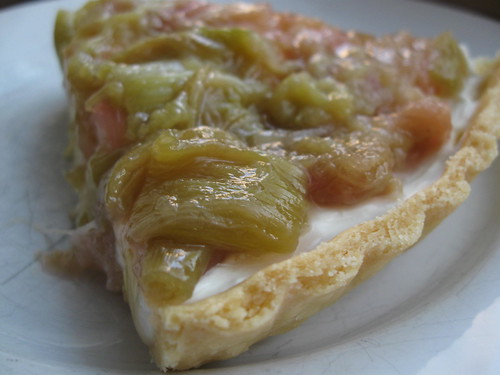
I know I should finish with an existentialist recipe but to be honest, i'm not sure eating was that important for them. While it's true that Sartre and Beauvoir loved to eat in the best restaurants of Montparnasse in later life, the people in St. Germain-des-Près were more concerned with smoking and dancing to jazz in caves. So I'll post a recipe for Chrissi instead who asked me for something with rhubarb. Rhubarb tart is, of course, the most classic and obvious way to use rhubarb. For other inspiring ways of baking with it, there's Denise's star anis rhubarb, Luisa's rhubarb pie, Molly's roasted rhubarb and Tracy's rhubarb and strawberry compote.

Rhubarb tart (adapted from Nigella Lawson's How to be a Domestic Goddess)


1 sweet pastry shell (I stuck with the recipe I used at Easter which guarantees non shrink pastry).

For the pastry

1 whole egg
A splash of vanilla essence
50g icing sugar
200g plain flour
A good pinch of salt
125 cold unsalted butter, cut into pieces


For the filling

1kg rhubarb (untrimmed weight)
300g caster sugar

1 small tub of mascarpone (about 250g)
100g cream cheese
100g double cream
2tbsp caster sugar

1. Wash and trim the rhubarb. Cut it into 2cm pieces and places in a shallow ovenproof dish. Sprinkle the sugar all over, cover with foil and bake at 190°C for about 45 mintues or until soft and juicy. Leave to cool, then strain it. I prefer not to keep the juice for the glaze because I think it makes the whole thing too sloppy but the choice is yours.
2. While it's cooling, make the pastry. Whisk together the egg, vanilla and icing sugar and 1 tbsp of cold water. In another bowl, mix together the flour and salt. Add the cubes of butter and rub in with your fingertips until you have a texture like breadcrumbs. Add the egg mixture a little at a time and blend until the mixture sticks together.
3. Tip it out onto a work surface and press it together into a flattened ball. Wrap in clingfilm and leave to chill in the fridge for at least 1 hour.
4. When the time's up, roll the pastry out onto a floured work surface until it fits a 23cm loose bottomed pie tin, leaving an overhang as thick as your finger. Repair any holes with leftover pastry, prick the bottom all over with a fork, press a piece of non-stick kitchen foil into the tin so it covers the pastry case and chill in the freezer for 20 minutes.
5. Fill the foil with dried beans, rice or pasta and bake in the oven at 180C for 10 minutes, then remove the foil and beans. Push the sides back up with your finger if they've drooped, then bake the uncovered case for another 15 minutes or until golden brown and crisp. Remove from the oven, trim off the excess pastry with a sharp knife and leave to cool to room temperature. Turn the oven down to 150C .
6. To put the tart together, whisk together the mascarpone,cream cheese and cream until soft and thick. Add the sugar and pour the cream mixture into the pastry case.

Best enjoyed on a perfect spring day.